The carbon footprint of a photo shoot nobody talks about.
AI and the environment. Data centers and photo shoots. An honest look at the tradeoff.
Every few weeks another article surfaces about AI's environmental cost. Data centers. Energy consumption. Water usage. The numbers are real. I'm not here to dismiss them.
But I am here to ask a question these articles almost never ask: compared to what?
The photo shoot nobody audits.
I've spent twenty years shooting food. Most of those were small, local jobs. A photographer, maybe a stylist, a client. Not a massive crew. Still: somebody drove to the location. Strobes cycled all day. Food was bought, styled, partially used, and tossed. Surfaces, props, and backdrops were sourced for a single shoot and often never used again.
Even a modest half-day shoot involves a car trip, a few hundred watts of strobe and modeling lights cycling all day, and a grocery run where half the food ends up in the trash because you need backup plates, backup ingredients, and options the client never picks.
If the results don't land? You reschedule. Drive back. Buy more food. Start over.
Nobody measures any of this. There's no carbon audit for a cheese photo.
And for most small brands, even that's out of reach.
The brands I work with aren't booking big productions. Most of them have never hired a photographer at all. They're using their phones, asking a friend, or pulling from stock libraries. The alternative to AI-directed content isn't a professional shoot. It's no professional content, period.
AI didn't replace a production crew. It replaced the absence of one. And the environmental cost of a few seconds of GPU inference is a fraction of even the smallest traditional shoot.
A small photo shoot
- 1-3 people driving to location
- Strobe lighting running half a day
- Food purchased, styled, mostly wasted
- Props and surfaces sourced and discarded
- Reshoot if results miss the mark
AI-directed session
- One person, one laptop
- GPU inference: seconds per image
- Zero food waste
- No travel, no physical materials
- Iterations are instant, not reshoots
This is not a claim of carbon neutrality. It's a comparison of actual workflows.
One recipe. Two realities.
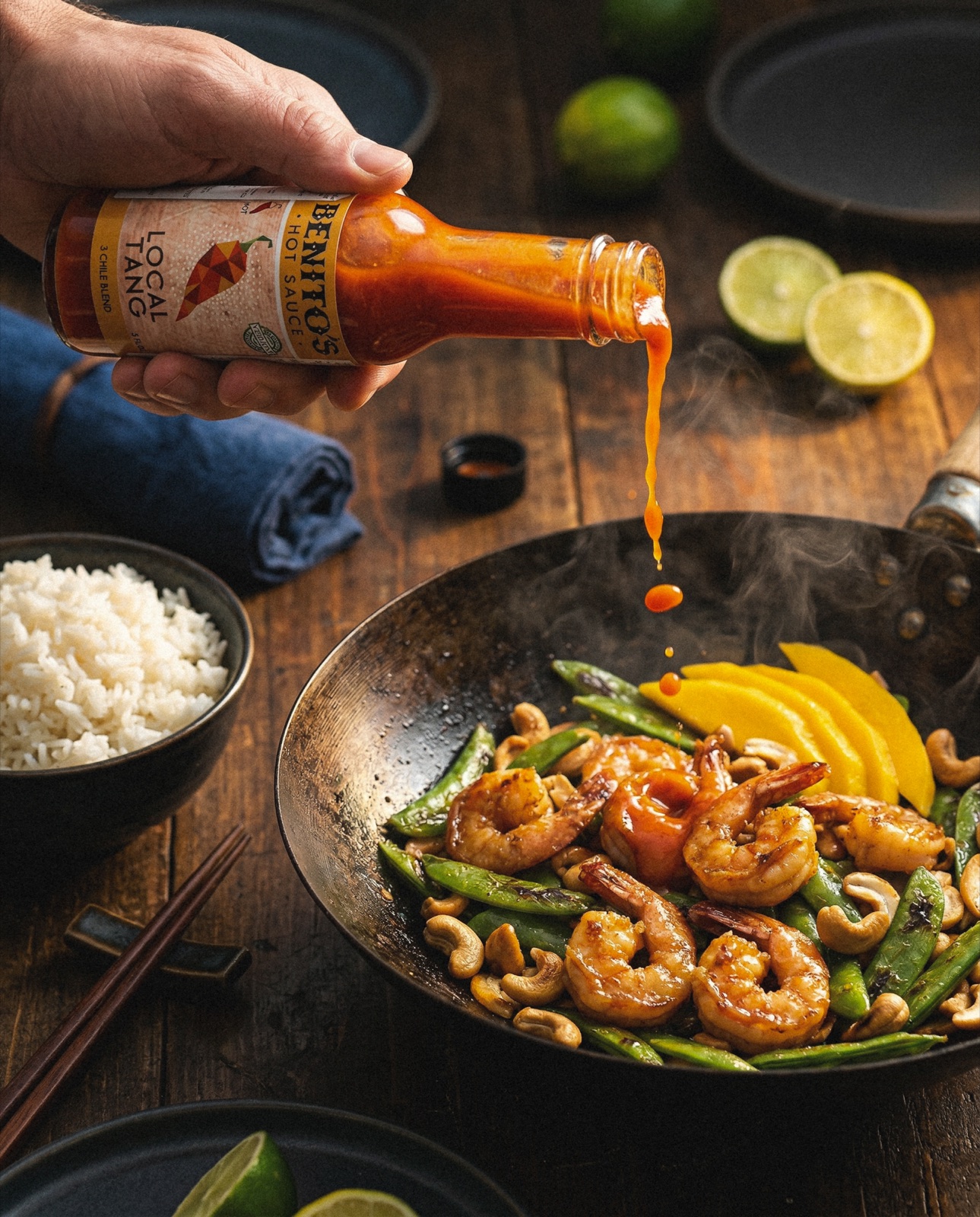
Consider a single recipe image. A brand wants a hero shot of their hot sauce on a Thai mango shrimp stir fry.
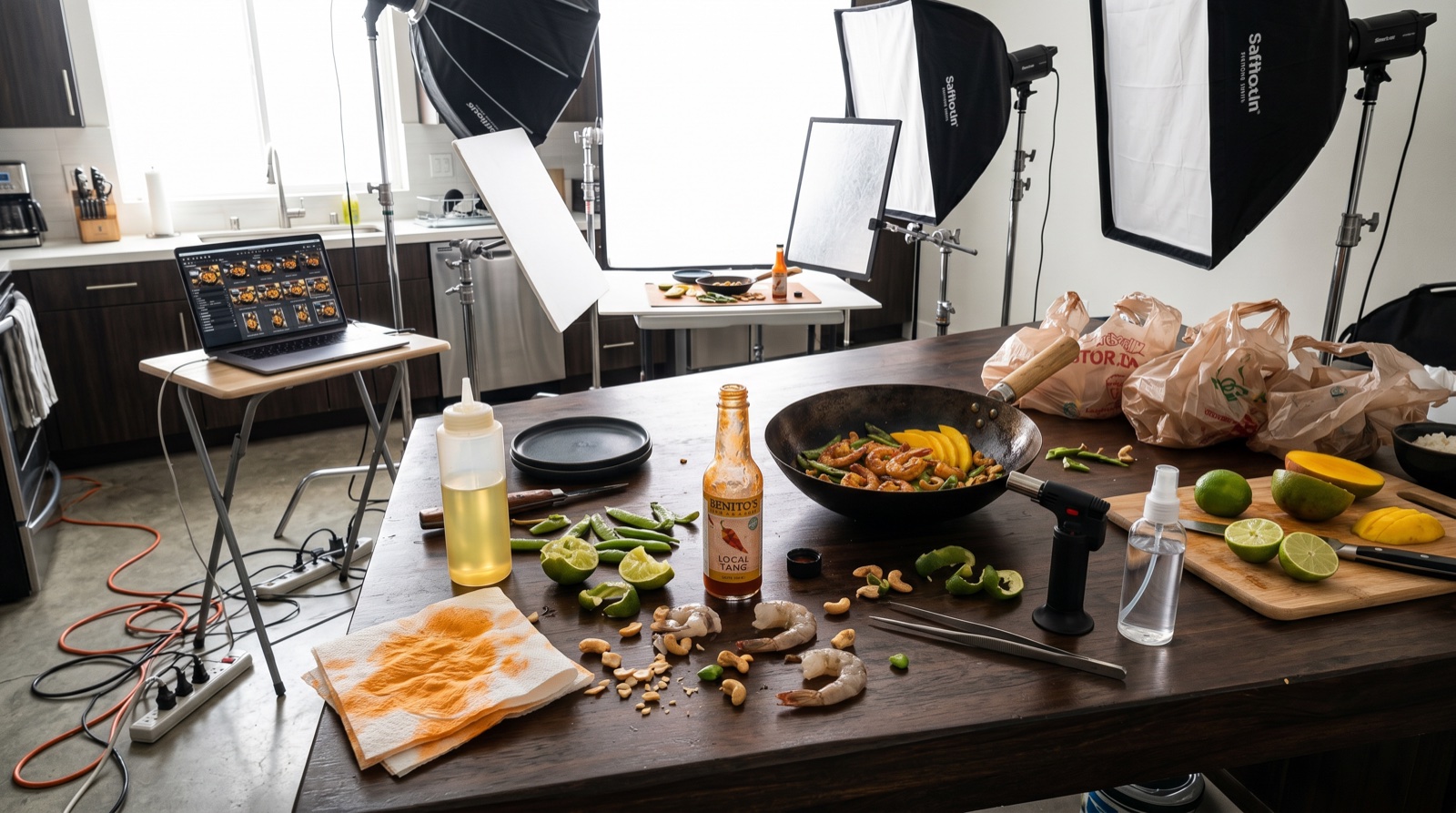
Traditional route: buy three to four times the ingredients you need. Cook multiple plates. Style, shoot, restyle, reshoot. Half the food ends up in the trash. That's one image.
My route: one laptop, one prompt informed by twenty years of directing food.
What you see
What it actually takes
The infrastructure hypocrisy.
The data centers that power AI image generation are the same ones that power everything else you use without thinking about it. Google Sheets. Canva. iCloud. Instagram. Spotify. Netflix. Slack. Zoom.
Nobody is writing op-eds about the environmental ethics of a shared spreadsheet. Nobody is demanding that Canva users justify their carbon footprint. Nobody boycotts cloud storage because it runs on electricity. Photoshop and Lightroom sync to Adobe's cloud, process files through cloud-based AI features, and run on the same infrastructure. Every photographer already uses data centers. They just don't think of it that way.
But the moment a small business uses a GPU to produce a product image, suddenly it's a crisis.
The International Energy Agency estimates that data centers consumed about 1.4 percent of global electricity in 2022, with streaming video and cloud services accounting for the vast majority of that load. AI workloads are growing, but they remain a fraction of what streaming, social media, and general cloud computing consume every day.
The outrage is selective. And the selectivity tells you it was never really about the environment.
If the concern were truly about data center energy, the conversation would start with streaming video, social media, and cloud storage. It doesn't. It starts and ends with AI, because AI is new, and new things are easy targets.
The trajectory matters.
Microsoft has committed to being carbon negative by 2030. Google has been matching 100% of its energy use with renewable purchases since 2017 and is pushing toward 24/7 carbon-free energy. Amazon Web Services is the world's largest corporate buyer of renewable energy.
The infrastructure behind AI is actively getting cleaner. The infrastructure behind traditional production, cars, grocery runs, disposable props, isn't on any roadmap at all.
What honesty looks like.
I'm not claiming AI content production is carbon neutral. Every computation uses energy.
But if you're going to have this conversation, have the whole conversation. Don't compare AI to zero. Compare it to what it actually replaces. And if you're going to single out AI image generation, apply the same scrutiny to every other cloud service you use without thinking about it.
The businesses I work with are small, independent brands. A craft brewery in Vermont. A family making olive oil in Tuscany. A small vineyard in South Africa. They don't have production budgets. AI gives them access to visual content that would otherwise be completely out of reach. The alternative isn't a zero-impact photo shoot. The alternative is no professional content at all.
Even this website was built with AI. Static HTML served from a CDN. No WordPress, no Squarespace, no CMS running database queries on every page load. Just flat files delivered from the closest server. The average website produces about 4.6 grams of CO2 per page view. A static site with no backend, no framework bloat, and optimized images is about as light as a website gets.
I'm not pretending to be green. I'm saying the math is better, and it's getting better every year.
Curious?
If you're an independent food or beverage brand and you want to see what directed content looks like for your product, I'll produce three custom images, on me. No pitch. No commitment. Just see it with your own eyes and decide from there.